LogoIcon with three horizontal white lines centered on a dark rounded square, symbolizing a menu button.
Mobile app screen showing breakfast food favorites with search bar, add food and build recipe buttons, and a list of breakfast items with quantities and grams.
Collage of mobile app screens showing a food and nutrition tracker with meal logging, trending foods, food details, and recipe features.
Mobile app screen showing food logging options with sections for Breakfast, Lunch, Dinner, and Snack, plus a food log button and navigation menu.
Rebuilding Food Search & Protein Tracking for PKU and Metabolic Disorders
Conceptual Product Redesign
|
UX Research
|
Mobile UX

UX Research & Synthesis

Product Redesign

Health & Accessibility UX

Information Architecture

Cognitive Load Reduction

Interaction Design

Systems Thinking

I led a concept redesign of Flok Health’s Eat feature, focusing on reducing cognitive load for people managing PKU and other metabolic disorders.The work reimagines food search and protein tracking into clear, familiar workflows that support both caregivers and independent patients during high stakes daily use.
Timeline:
Jan 2025 - May 2025
5 Months
Role:
End-to-end Product Design (Research → Prototyping)
Team:
Solo Designer (conceptual redesign)
Tools:
Figma, FigJam
OVERVIEW
Project Context
This project was my senior capstone for my UX design program. I partnered with Flok Health after independently reaching out to organizations that support PKU and metabolic conditions, motivated by a close personal connection to the space. Flok identified the Eat feature as an area where design support would be most valuable.
The work is future facing and exploratory. While the designs were not implemented, the goal was to think critically about how this experience could evolve as Flok grows and the product becomes more complex.
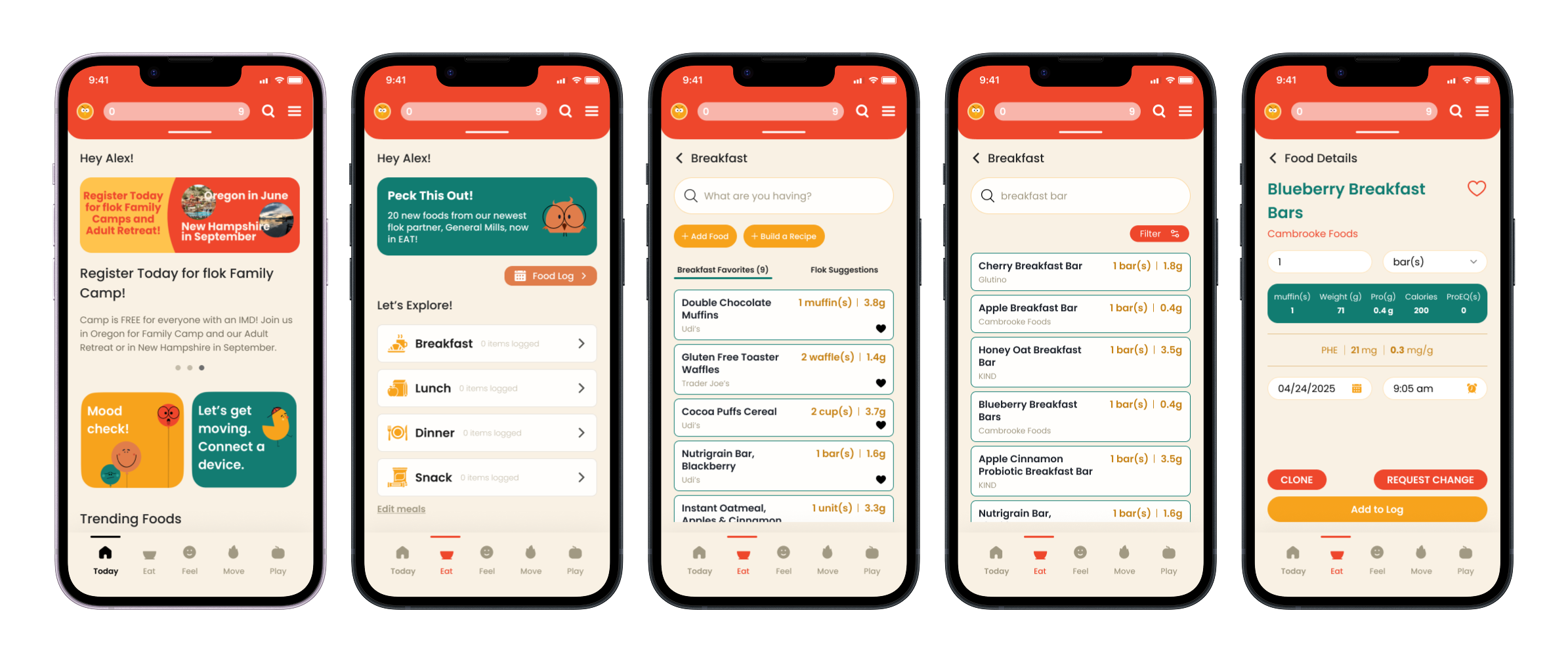
Five iPhone screens showing a food tracking app with registration, meal exploration, breakfast favorites, food search, and food details for Blueberry Breakfast Bars.
THE PROBLEM
Designing for a high-stakes user group
Phenylketonuria (PKU) and related metabolic disorders require strict protein management. Even small inaccuracies can have serious health consequences. Unlike mainstream nutrition apps, these users are not optimizing for fitness or weight goals. They are managing a medical condition where clarity and accuracy matter.
Many users already know which foods are safe, but still need to check protein content, log meals for clinical review, and feel confident they are staying within safe limits. Early on, I realized the challenge was not increasing engagement, but reducing the mental effort required in critical moments.
Why the Eat feature mattered
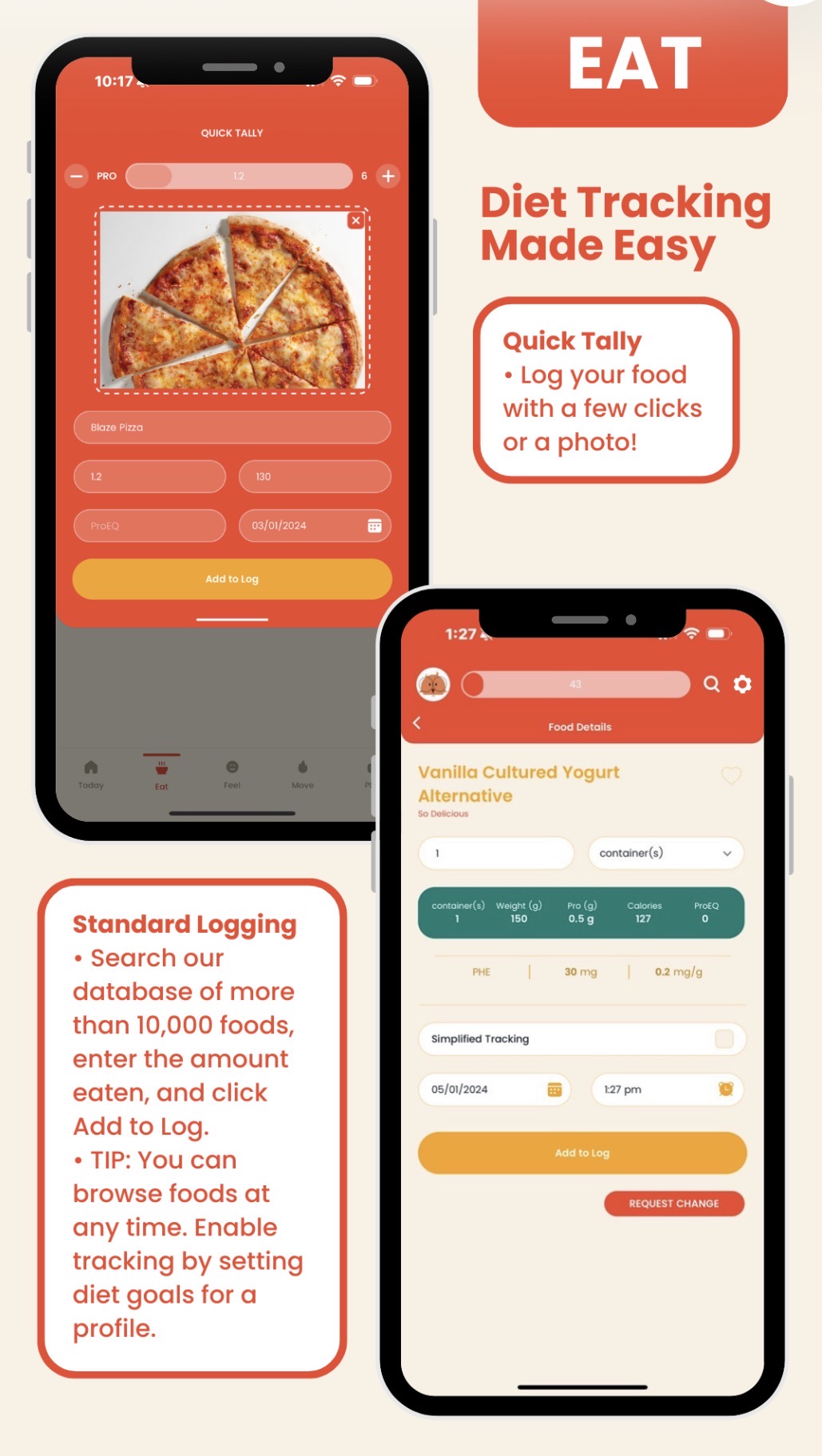
Eat is where users look up foods, track protein intake, manage recipes and favorites, and create logs that can be shared with clinicians. While it is one part of a broader app that also includes mood tracking, activity tracking, and future community features, Eat plays a central role in how users manage their health day to day.
Where the experience broke down
During an early walkthrough, a PKU user summarized the experience clearly.
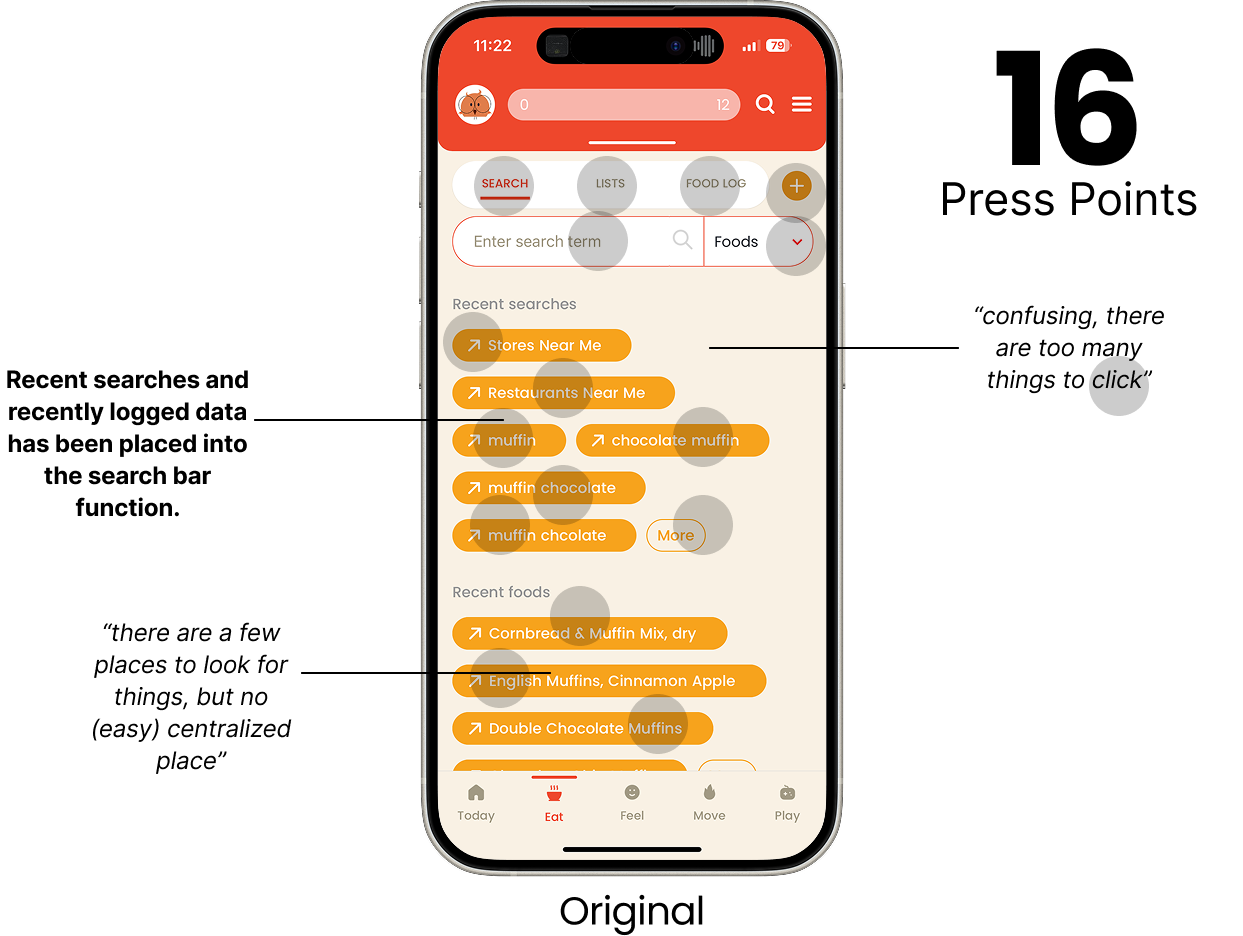
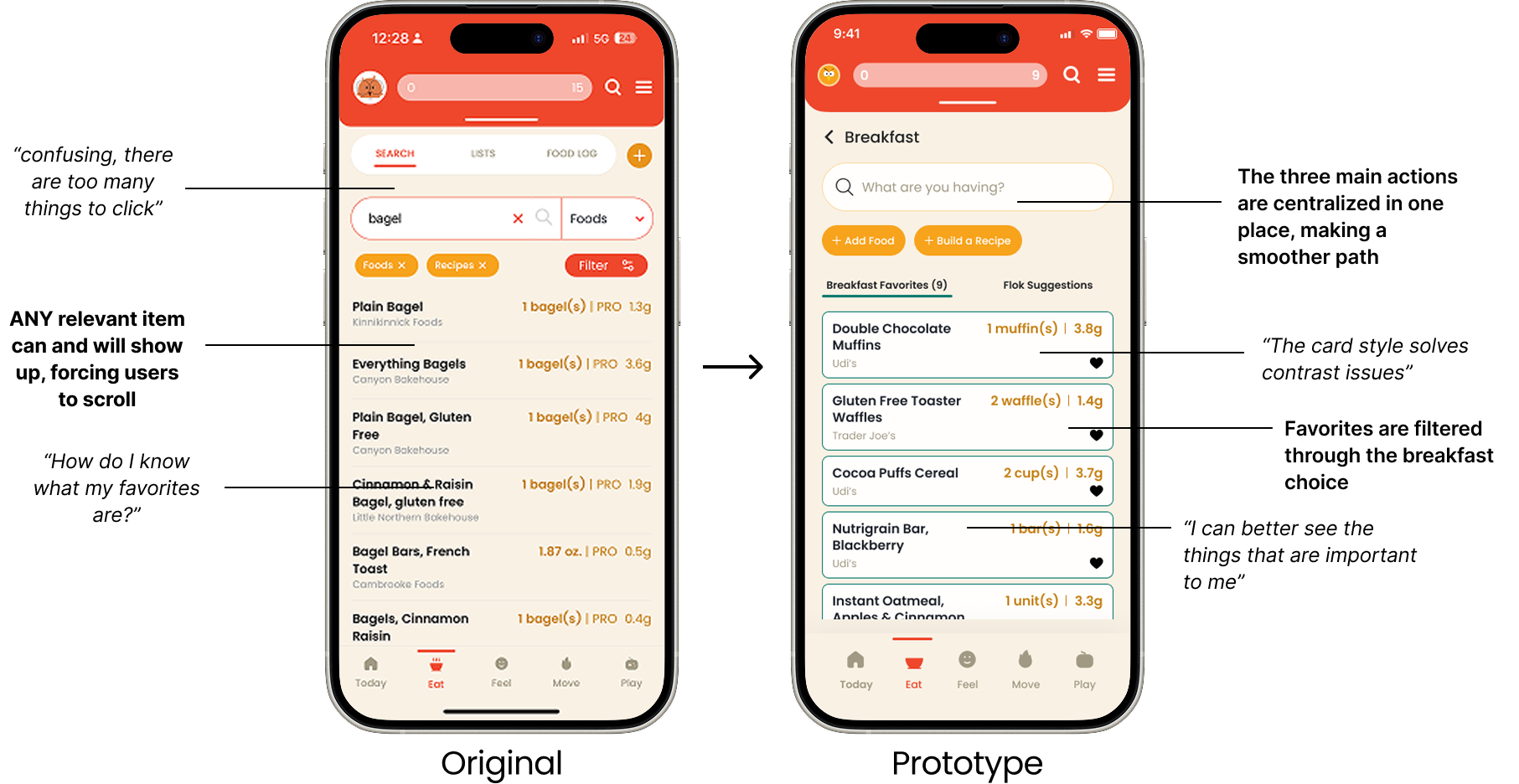
“There are too many things to press. I do not know what I am doing.”
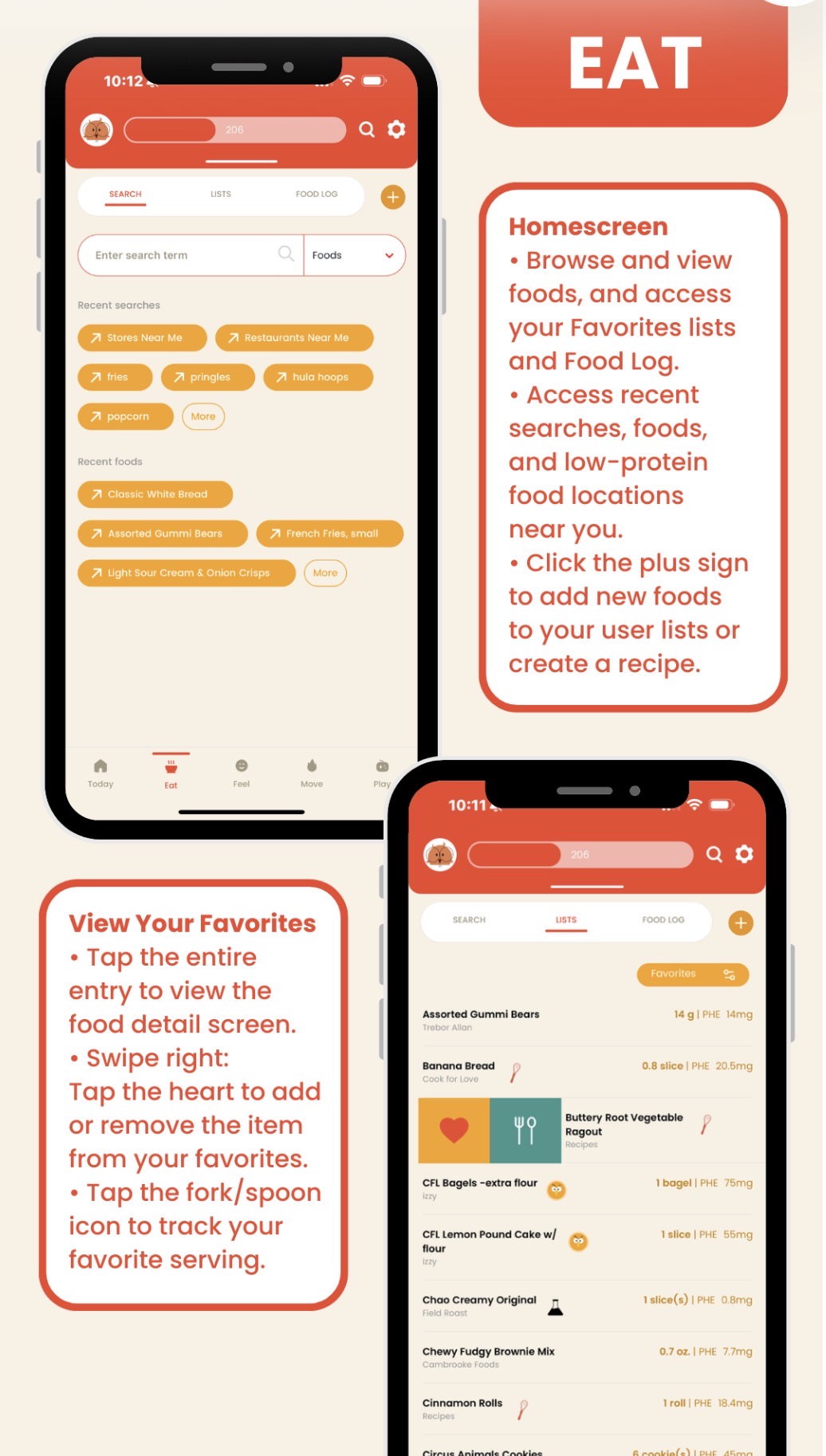
On a single screen, users were asked to search foods, view favorites, access recently logged items, add recipes, create custom foods, and navigate features that were either underused or unreliable. This lack of focus made it easy for users to lose momentum, especially during everyday use when they just wanted to log something quickly.
The issue was not missing functionality. It was too much competing functionality at once.
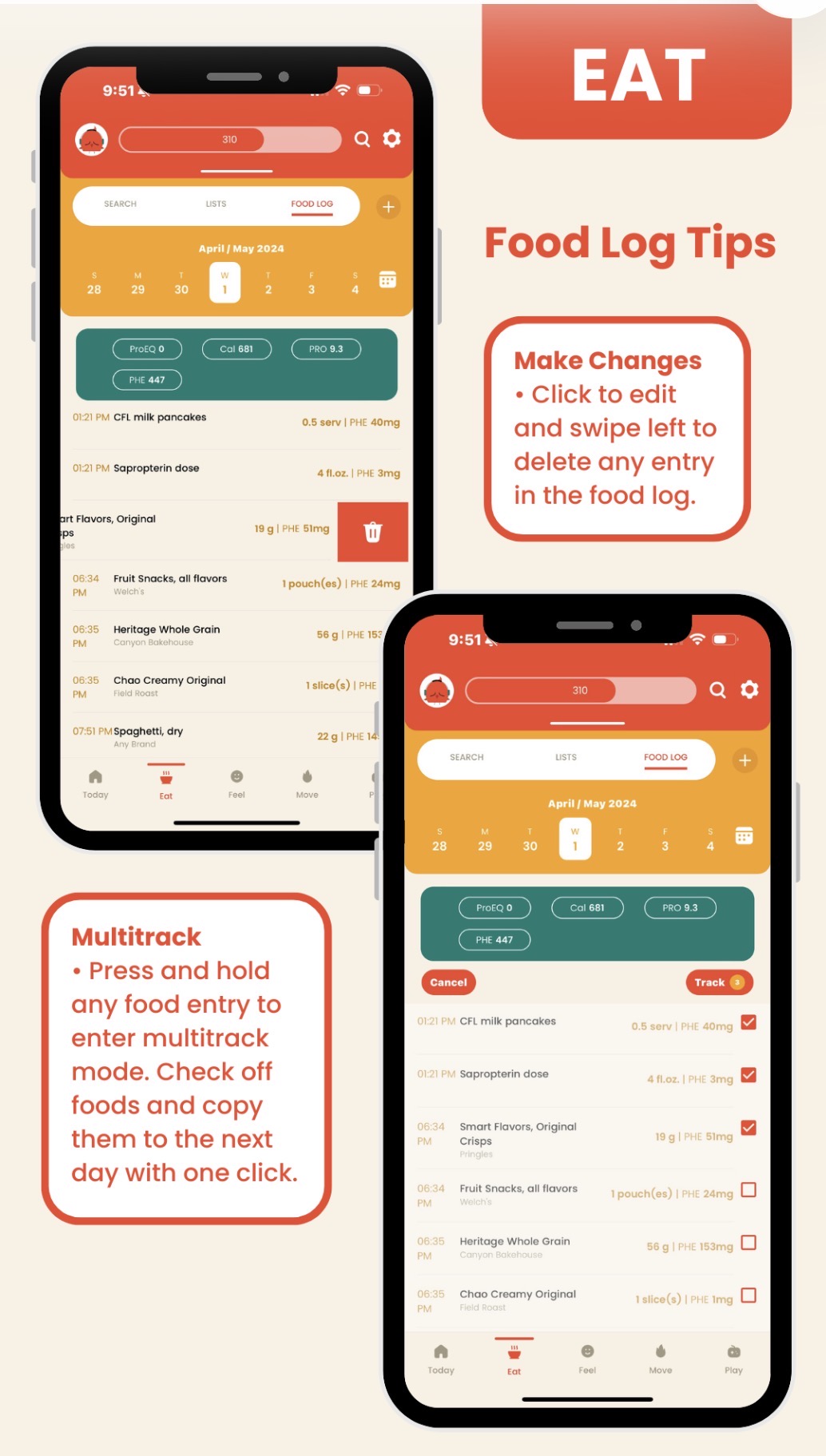
Two smartphone screens of a food tracking app showing search with recent foods on the left and meal logging options for breakfast, lunch, dinner, and snack on the right.
RESEARCH AND INSIGHTS
Understanding the users
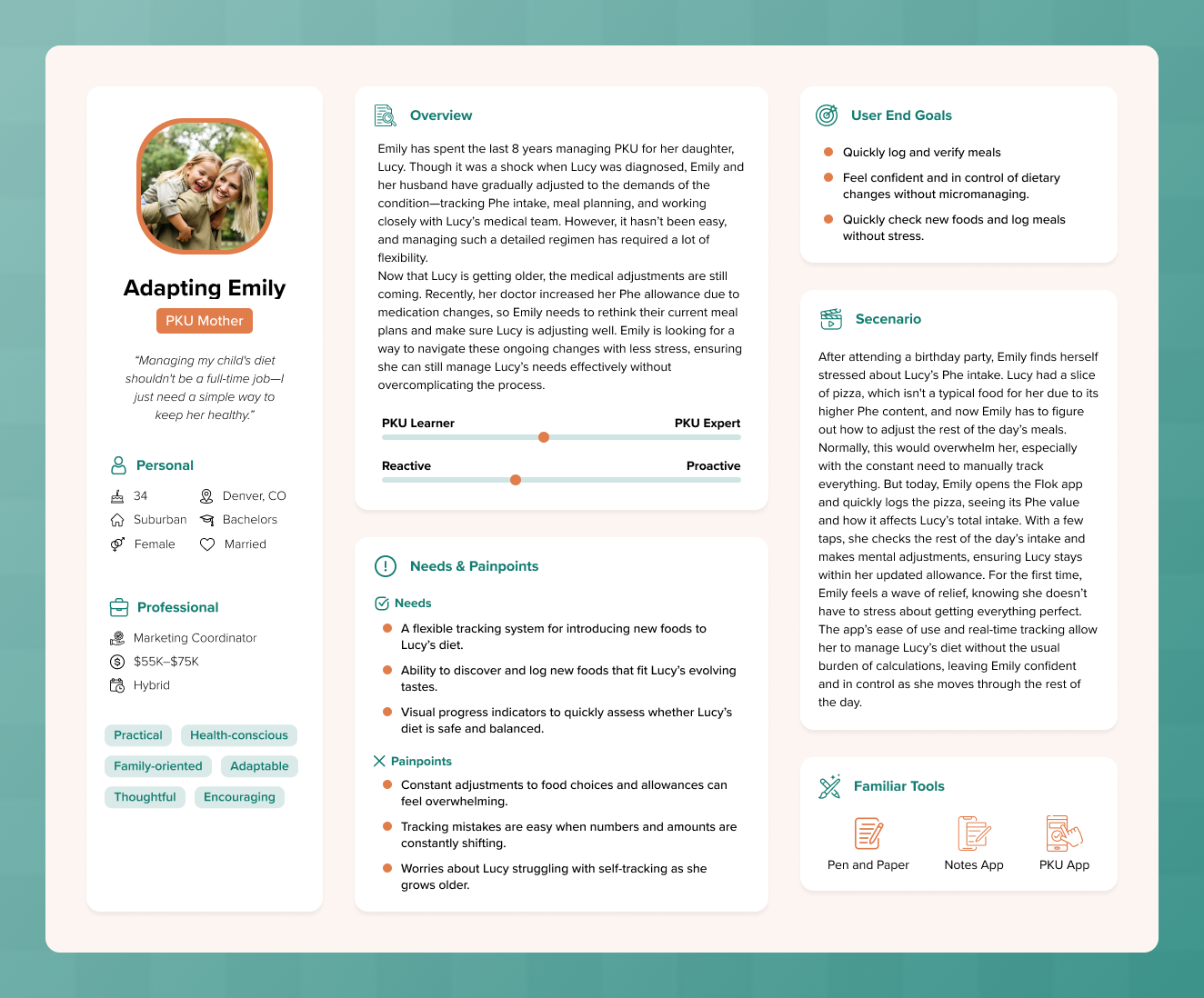
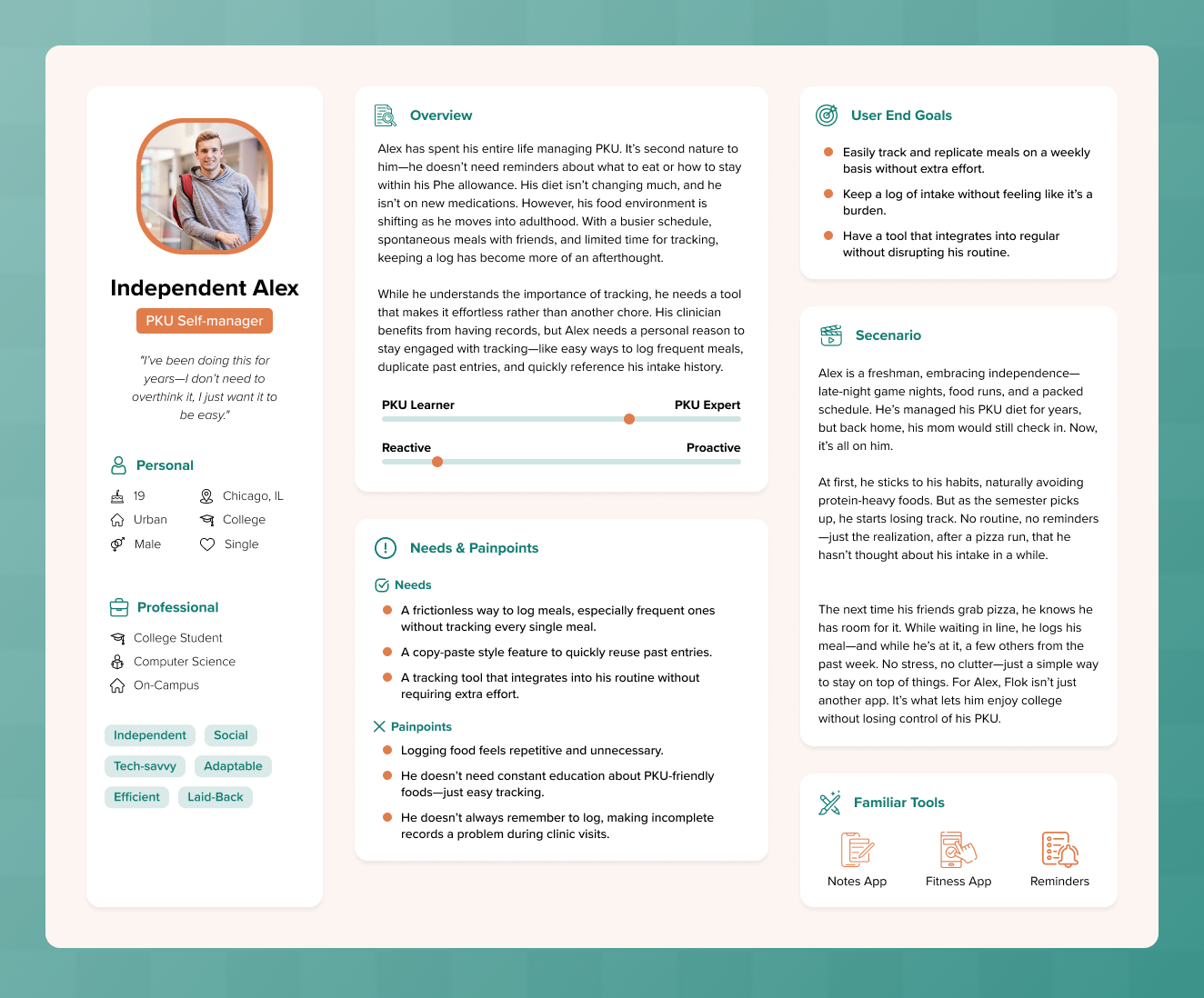
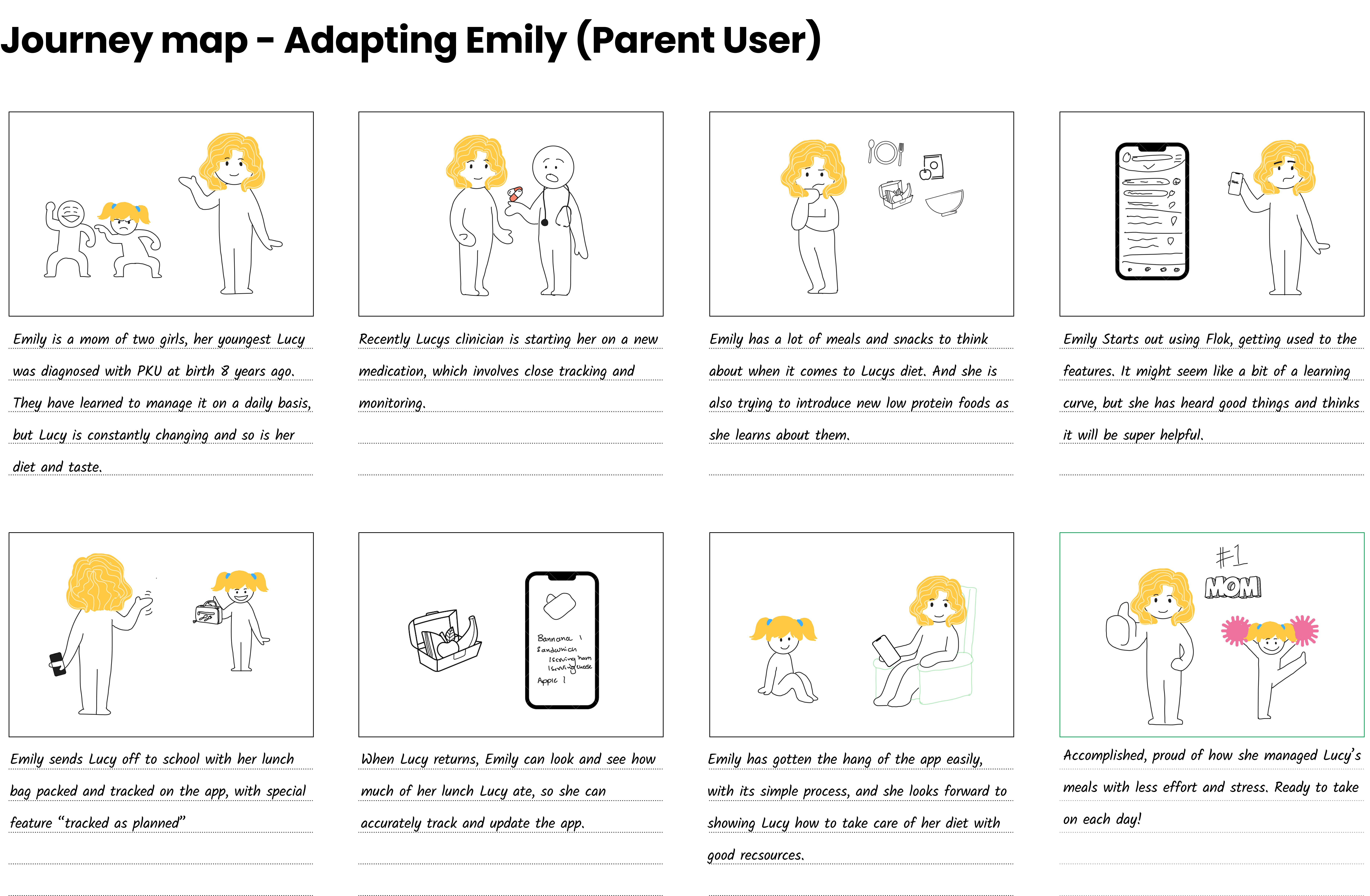
Through research, I identified two primary user groups. Direct patients such as teens and adults managing their own intake, and caregivers such as parents, teachers, or guardians managing food for others.
Persona profile for Emily, a 34-year-old female PKU mother from Denver, CO, showing her personal and professional details, goals, needs, challenges, scenario, and familiar tools for managing her daughter's PKU diet.Profile of Independent Alex, a 19-year-old college student in Chicago managing PKU, detailing his personal info, needs, goals, and scenario of balancing diet and college life.
While their routines differ, their needs overlap. They value speed, predictability, and flexibility in how deeply they engage at any given moment. Designing separate experiences would have added complexity, so I focused on shared mental models that could support both groups.
Comparative research
I studied diet tracking apps, protein trackers, PKU specific tools, and Flok’s earlier web experience. Across tools, meal based organization consistently worked because it matches how people naturally think about food.
At the same time, most tools prioritize calories over protein, bury key information behind multiple steps, and assume users want to optimize metrics. This reinforced that Flok’s users needed clarity and restraint, not motivation or goal chasing.
Comparative analysis table of six meal tracking apps showing position, key features, screenshots, audience, weaknesses, reviews, cost, and opportunities.
What makes Flok different
Flok maintains a growing database of over ten thousand foods, sourcing protein values directly from manufacturers. This avoids label rounding that may be acceptable for the general population but risky for users with strict protein limits.
Seeing this level of data accuracy reinforced the importance of designing an interface that makes correct information easy to access without adding mental strain.
Comparison of two nutrition facts labels showing protein content difference: rounded label with 3g protein and flok verified value with accurate protein 2.4g, marked with a green check.
DESIGN APPROACH
Redefining the goal
One of the first mindset shifts I had to make was redefining success. The goal was not to help users reach a protein target, but to help them stay under a safe limit.
This distinction guided what information was emphasized, what was deprioritized, and which ideas were intentionally removed.
Simplifying actions, not features
One of the first things I did was count how many tap and click points existed on the Eat screen. The number alone helped explain why the experience felt overwhelming.
Rather than removing features outright, I focused on clarifying the primary action, organizing secondary actions more intentionally, and creating shortcuts for frequent users without overwhelming new ones. The guiding principle became simple. If everything is prioritized, nothing is. I focused on the most important action first and let everything else support it.
A decision to remove, not add
Early exploration included a weekly protein summary inspired by fitness and diet apps. While this pattern was common elsewhere, feedback helped me realize it conflicted with how PKU users think about their health. Protein tracking here is about awareness and management, not achievement.
Instead, that space was repurposed to highlight new foods and updates, helping users stay informed without reinforcing goal oriented behavior.
STRUCTURING THE EXPERIENCE
The meal based decision
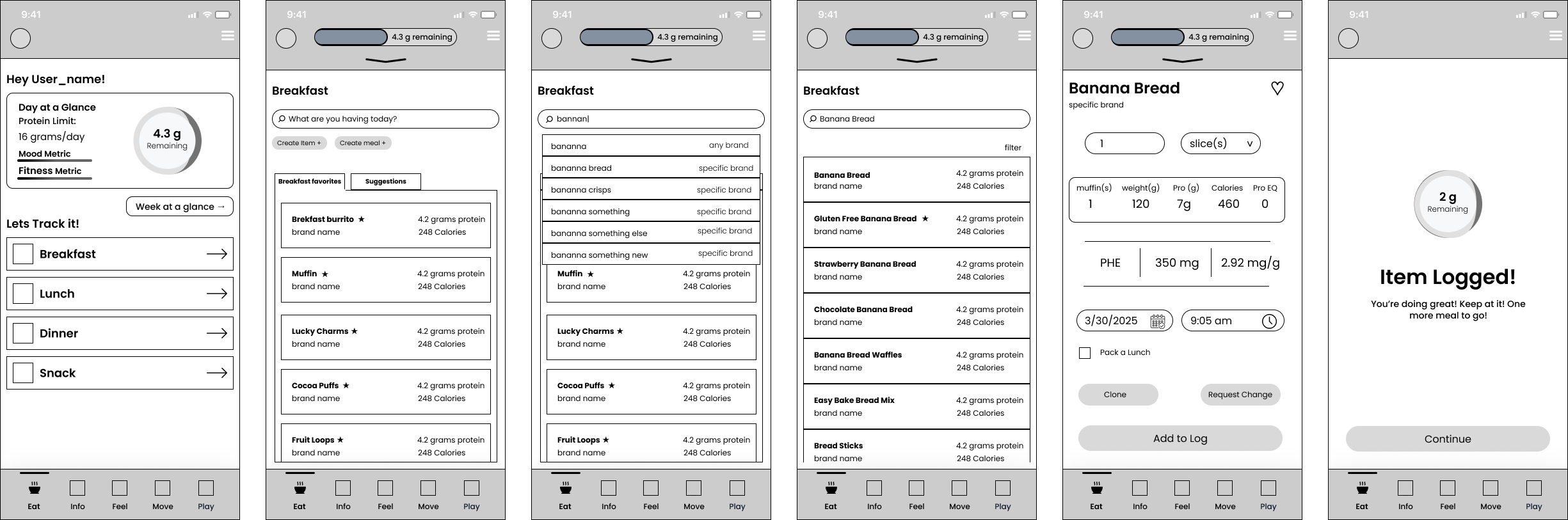
The most impactful structural change I made was organizing tracking by meals rather than a single running list. This aligned with familiar mental models, improved scannability, and created natural entry points for different depths of use.
This decision also solved secondary problems. Favorites could now be filtered by meal, allowing users to quickly log foods they eat regularly without scrolling through long, unfocused lists. While this approach differed significantly from Flok’s existing structure, it provided clarity without removing flexibility.
Supporting different depths of use
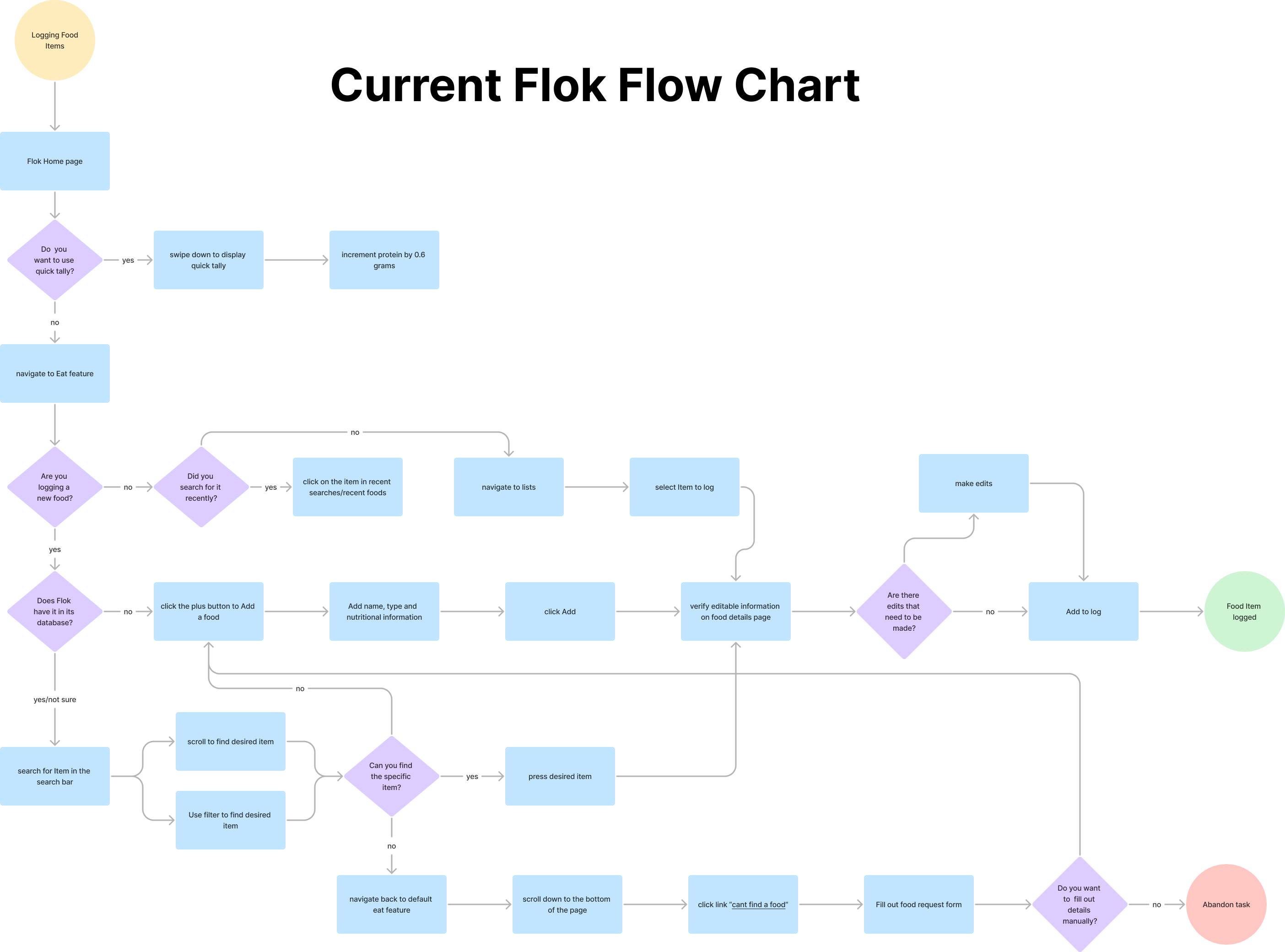
The redesigned flow supports quick logging of familiar foods, checking protein for something new, and returning later to edit entries.
Users move through one clear path and stop when they have gone far enough, rather than being forced into an all or nothing experience.
FINAL SOLUTION
What changed
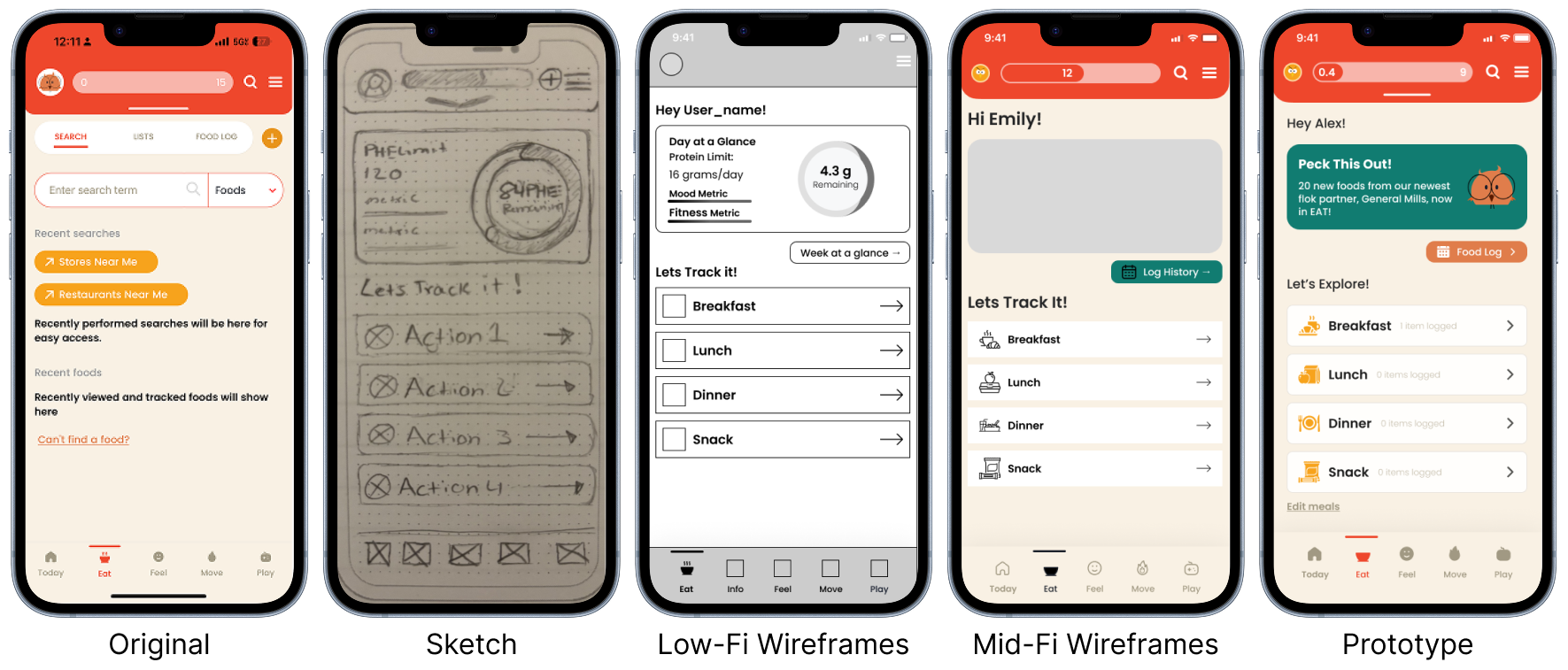
The final concept redesign centralizes primary actions, uses meal based grouping to reduce scanning, reduces competing entry points, improves visual hierarchy around protein information, and creates clearer return and edit paths.
Why it works
The experience supports real world use. It is quick when users are busy, detailed when accuracy matters, and familiar enough to use daily without friction. Rather than asking users to learn a new system, the design works with how they already think and track food day to day.
Five smartphone screens showing a health and nutrition app interface with features like registration, meal logging, food search and favorites, and detailed nutritional info for Blueberry Breakfast Bars.
LEARNINGS AND NEXT STEPS
Why this project mattered to me
I pursued this partnership intentionally because of a close personal connection to PKU. That perspective helped keep the work grounded in real needs while still making objective design decisions.
Outcomes beyond the capstone
After completing the project, I was invited to continue working with Flok Health in a paid UX consulting role. While the designs were not implemented at the time, the work helped inform future thinking around the Eat feature.
Looking forward
With more time and access, future work would include usability testing with a broader PKU population, accessibility refinements, and continued iteration as Flok grows.